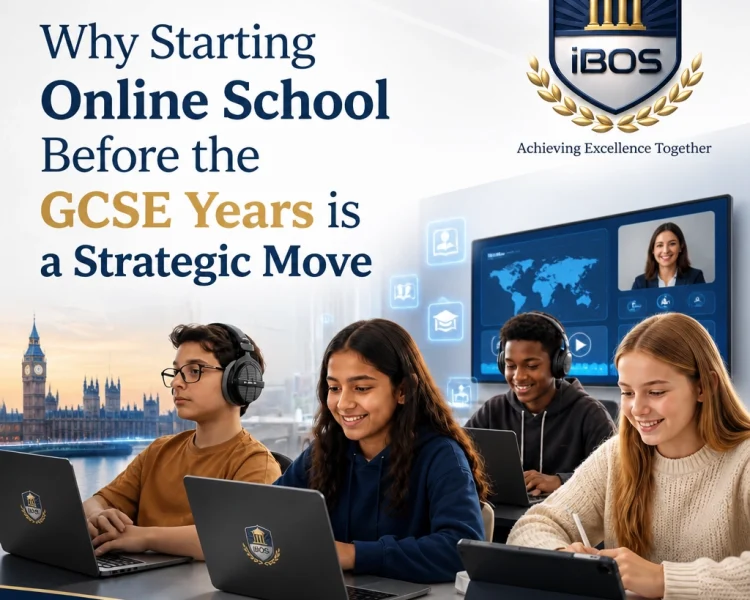
Why Starting Online School Before the GCSE Years is a Strategic Move
For many parents, the term ‘GCSE’ marks the official start of “serious” education. It is the moment when the stakes feel higher, the revision posters go up, and university pathways start to take shape. Because of this, many families wait until Year 10: the first official year of the General Certificate of Secondary Education (GCSE) course: to consider making a change to their child’s learning environment.
However, at iBOS (International British Online School), we are seeing a significant shift. More parents are choosing to transition to online British education during the “middle years”: specifically Key Stage 3 (Years 7, 8, and 9).
Why? Because jumping into a high-pressure exam environment while simultaneously adapting to a new school system can be overwhelming. By starting earlier, students build the academic foundations, study habits, and self-confidence they need to thrive when the exam years finally arrive.
In this guide, we explore why a proactive approach to online schooling before the GCSE years is a strategic move for your child’s future.
The Foundation: Why Key Stage 3 Matters More Than You Think
In the UK curriculum, Key Stage 3 (KS3) is often overlooked, but it is actually the engine room of academic success. This is the period where students move away from the generalist learning of primary school and begin to master the complex concepts required for secondary success.
Broadening Horizons Before Specialising
One of the greatest risks of starting the British curriculum too late is that students miss out on a broad range of subjects. During Years 7 to 9, students at iBOS explore everything from the humanities and creative arts to rigorous sciences.
This exploration is vital. It allows students to discover where their true passions lie before they are forced to narrow their choices for International GCSEs. If a student only joins the system in Year 10, they may choose subjects based on guesswork rather than a proven track record of enjoyment and success in KS3.
Building Subject-Specific “Depth”
The UK Department for Education notes that a strong KS3 curriculum is essential for preparing students for the rigours of later examinations. In Science, for instance, students move from basic facts to understanding complex systems and reasoning. In English, they begin to tackle literary critique and structured essay writing.
By starting with iBOS in Year 7 or 8, your child has three years to get used to British marking criteria, command words, and academic expectations. By the time they reach Year 10, they aren’t learning how to write an essay: they are learning how to perfect it.
Developing the “Independence Muscle” Early
Perhaps the biggest advantage of online learning is the development of independent study skills. In a traditional overcrowded classroom, students can often become “passive” learners, waiting for a teacher to prompt every action.
In the iBOS online secondary school, our live, timetabled lessons require students to be active participants. They must manage their digital workspace, engage in real-time discussions, and take responsibility for their own progress.
The Strategic Advantage of Study Habits
Developing these habits in Year 7 or 8 is a massive strategic advantage. If a student waits until the GCSE years to learn how to manage their time and work independently, they are trying to learn “how to learn” at the same time they are tackling difficult exam content.
By the time our pre-GCSE students reach Year 10, they are already experts in using our digital tools, communicating with teachers, and organising their schedules. They have developed what we call the “Independence Muscle”: the ability to take ownership of their education.
Book a consultation with iBOS to discuss your child’s education pathway and find out how online British learning can support your family’s goals.
Book a Consultation
A Smoother Transition for International and Relocating Families
For families living outside the UK or those who relocate frequently, the transition into the British system can be a “culture shock.” Each country has a different sequence for teaching maths, science, and history.
Closing the “Curriculum Gap”
If an international student joins the British system at the start of Year 10, they may find significant gaps in their knowledge. For example, the British curriculum might have covered certain algebraic concepts in Year 8 that the student’s previous school hasn’t touched yet.
By starting in the middle school years (KS3), students have a “buffer period.” Our qualified teachers at iBOS: all based in our London school: can identify these gaps early and help students align their knowledge with UK standards. This ensures that when they reach their Pearson Edexcel examinations, they are standing on solid ground.
Emotional Consistency
Relocation is stressful. Changing schools is stressful. For globally mobile families, iBOS provides a “school that moves with you.” If you move from Dubai to London, or Singapore to New York, your child’s teachers, classmates, and curriculum remain exactly the same. Starting this journey before the high-pressure GCSE years allows your child to build a stable social and academic base that stays constant, regardless of your physical location.

Avoiding the “GCSE Panic”
We have all seen it: the sudden spike in stress that hits families as Year 10 approaches. Parents scramble for tutors, students feel the weight of expectation, and the “fun” of learning often disappears.
Starting online school earlier helps eliminate this “GCSE Panic.” Because iBOS follows the complete British National Curriculum from Primary School through to Sixth Form, the transition from Year 9 to Year 10 feels like a natural step, not a giant leap into the unknown.
Proactive Subject Planning
At iBOS, we don’t just teach; we mentor. During the pre-GCSE years, our teachers work with students to identify their strengths. We provide expert guidance on which GCSE subjects will best support their future ambitions: whether that’s a Russell Group university in the UK or a leading institution in the US. This proactive planning turns a stressful decision-making period into an empowering one.
Why iBOS is the Ideal Pre-GCSE Partner
iBOS is not just a platform; it is a London-based school infrastructure. Unlike other online options that rely on recorded videos, we offer:
- Live, Timetabled Lessons: Every lesson is interactive and led by a UK-qualified teacher in real-time.
- Small Class Sizes: Your child won’t get lost in the crowd. They receive the individual attention they need to build confidence.
- Full Pastoral Care: We focus on the whole child, ensuring their emotional wellbeing is supported as they grow.
- Accredited Excellence: As a school accredited by the Council of International Schools (CIS), we maintain the highest global standards.
Starting your journey with iBOS in Key Stage 3 is more than just an academic choice: it is a commitment to giving your child the best possible start to their secondary education.
Frequently Asked Questions
1. Is it too early to start thinking about GCSEs in Year 7?
It is never too early to build the foundational skills. While we don’t advocate for “exam-drilling” eleven-year-olds, we do believe that learning the British style of inquiry, analysis, and independent study early makes the GCSE years much more manageable and less stressful.
2. Can my child switch to iBOS mid-year during Key Stage 3?
Yes. We often welcome students mid-term, especially families who are relocating or those who feel their current school environment isn’t providing the right level of support or challenge.
3. How do you manage the social transition for middle-schoolers online?
Social development is a priority at iBOS. Through live classroom discussions, group projects, and our virtual community, students build strong friendships with peers from around the world. Many students find the online environment less intimidating than a traditional large secondary school.
4. What subjects does iBOS offer in Years 7-9?
We follow the full British National Curriculum, including English, Mathematics, Science, History, Geography, Modern Foreign Languages, Art, and more. This broad base ensures students are well-rounded and prepared for any GCSE pathway they choose.
5. Are the teachers at iBOS the same ones who teach GCSEs?
Yes. Our teachers are subject specialists who often teach across both Key Stage 3 and Key Stage 4. This means they know exactly what skills a Year 8 student needs to develop to be successful in Year 11.
Final Thoughts: A Strategic Investment in Your Child’s Confidence
Education is a marathon, not a sprint. While the GCSE years are the “home stretch,” the work done in the middle years determines how comfortably your child finishes the race.
By choosing iBOS before the GCSE years, you are giving your child the gift of time. Time to adapt, time to build confidence, and time to master the skills of a modern, independent learner.
Book a consultation with iBOS today to discuss your child’s education pathway and find out how online British learning can support your family’s goals.